
CQ CQ CQ DE N4TYV N4TYV N4TYV K
Morse Code decoded: CQ = calling anyone | DE = this is | N4TYV = my assigned callsign | K = go ahead
http://www.qsl.net/n4tyv/
https://techno001.tripod.com/
CQ CQ CQ DE N4TYV N4TYV N4TYV K
Morse Code
decoded: CQ = calling anyone | DE = this is | N4TYV = my assigned
callsign | K = go ahead
"Site Map"
Note:
Click on Site Map for links to all my web pages.
Links in "quotes" are my web pages, links without
quotes are to external web sites.
These webpages began back in 1998 with radio and weather information later expanding into politics.
Public-Safety
Digital Encryption: the Latest Roadblock against Citizens
"The Citizens Problem"
"Openness of Government and Public-Safety Services"

Old Openness Site by the Original Author
is No Longer Maintained
The Amateur Radio (Ham Radio) Hobby
Getting an amateur radio
license became a lot easier beginning in 2007 because you no
longer have to know Morse code.
http://www.hello-radio.org/ Getting Started in Amateur Radio
http://www.arrl.org/arrlvec/license-requirements.html Amateur Radio License Levels and
Requirements
With an amateur radio license you use it for friendly chat around the world. You can build your own radio equipment. You can use amateur radio satellites up in space. You can bounce radio signals off of the moon.
Many of the technology and inventions that have come around this century have come around from ham radio. The IP protocol that the Internet works on today, basically was pioneered by ham radio operators as an experimental protocol. Two-way text messaging was common for hams in the mid 1980s before consumers had it in the late 2000s.
The use of ham radios during times of disasters is priceless. When a hurricane, a major tornado, a major earthquake, a major flood, a major terrorist attack, or other disasters disrupts the communication infrastructure, ham radio operators go into action to set up a emergency communications.
Some famous people
obtained an Amateur Radio License
http://www.qsl.net/w5www/famous.html
The amateur radio service is a "Radiocommunications service for the purpose of self-training, intercommunication and technical investigations carried out by amateurs, that is, by duly authorized persons interested in radio technique solely with a personal aim and without pecuniary interest." Radio amateurs are trained and experienced in electronics, propagation theory, and communications techniques. Amateurs also respond swiftly and effectively to calls for communications assistance when normal channels are lost. The amateur service has significantly contributed to the development of radio technology. Amateur operators continue to fulfill certain public service radiocommunications requirements, and increase their skills relating to emergency communications. During natural disasters such as hurricanes, floods, and other events, amateur radio communications have been particularly effective, and in many cases have been the sole means of communicating from the scene of a disaster.
In addition to recreational use, amateurs use the amateur bands to provide public services in a variety of ways. The American Radio Relay League (ARRL) sponsored National Traffic System provides a nationwide network that carries thousands of messages monthly. This system is available in the event that regional or local disasters degrade the public communications systems. The Department of Defense (DOD) works closely with the amateur community in its Military Affiliate Radio System (MARS) network. Local amateur radio clubs provide communications support for community events, and are a source of trained radio operators to complement state and local communications personnel through the Amateur Radio Emergency Service (ARES) and Radio Amateur Civil Emergency Service (RACES) programs.
Amateurs, or "ham" radio operators, provide a unique service to the public while enjoying a popular, technical hobby. Many innovative uses of radio systems have been developed by amateurs for use in the amateur bands, such as packet-switched systems, amateur television, and the amateur-satellite service. Amateurs are always experimenting with point-to-point systems to push the state-of-the-art in antenna design and solid-state equipment, and to investigate the properties of signal propagation. Amateurs use Morse code, voice, packet-switched data, television, and satellite communications in the various frequency bands. It is estimated that there are more than 632,000 amateur radio operators in the United States, and over 2.4 million worldwide.
Personal Two-Way Radio Services with Free air time available to the Public
Information on the five major personal
radios services provided by the FCC
Personal Radio Steering Group
Amateur Radio
Service (ARS):
Description: Hobby (no
business allowed) communications service
Mode: All known modes of radio
communication.
Frequency bands: Several,
covering most of the radio spectrum, depending on license class.
Number of Channels: Each band
allows many frequencies depending on license class.
Types of units: all known
radio transmitter/receiver types.
Expected Average
Communications Range: Low range to infinite, depending on band,
equipment, and license class.
License Requirements: Amateur
Radio license, requiring written and Morse Code test (excluding
Tech. class). Three tier licensing system.
http://www.arrl.org/hamradio.html
http://wireless.fcc.gov/services/amateur/
http://www.access.gpo.gov/nara/cfr/waisidx_02/47cfr97_02.html
http://www.arrl.org/FandES/field/regulations/news/part97/
General Mobile
Radio Service (GMRS):
Description: Non-Hobby General
Communications
Mode: FM
Frequency Bands: 1
Number of Channels: 14
Expected Average Range of
Communications: 2 miles handheld, 10 miles mobile, 15 miles base
station, 15+ miles through repeater.
Types of units: Handheld,
mobile, base.
License Requirements: GMRS
license.
http://wireless.fcc.gov/services/personal/generalmobile/
http://www.access.gpo.gov/nara/cfr/waisidx_02/47cfr95_02.html
http://www.provide.net/~prsg/wi-gmrs.htm
http://www.gmrsweb.com/
Citizens Band
Radio Service (CB):
Description: Low-power HF
Radio Service.
Usage: General Communications.
Mode: AM and SSB
Frequency Bands: 1
Number of Channels: 40
Expected Average Range of
Communications: 1 mile handheld, 5 miles mobile, 12 miles base
station.
Types of units: Handheld,
mobile, base.
License Requirements: None
http://wireless.fcc.gov/services/personal/cb/
http://www.popularwireless.com/cbweb/index.html
CB Radio Operators Web Ring
http://www.reactintl.org/
Family Radio
Service (FRS):
Description: Low-power Non-Business
UHF radio service.
Usage: Non-hobby general
communications.
Mode: FM
Frequency Bands: 1
Number of Channels: 14
Expected Average Range of
Communications: less than 2 miles.
Types of units: Handheld only.
License Requirements: None
http://wireless.fcc.gov/services/personal/family/
http://www.provide.net/~prsg/frs-home.htm
http://www.gmrsweb.com/frslinks.html
Multi-Use Radio
Service (MURS):
Description: Non-Hobby General
communications service.
Mode: Narrow Band FM.
Frequency Band: VHF
Number of Channels: 5
Types of units: VHF
transmitter with proper bandwidth.
Expected Communications Range:
less than 5 miles.
License Requirements: None
http://www.geocities.com/horseshoe7/MURS.html
49-MHz Low-Power
Service:
Description: Very low-power
radio service.
Usage: General communications.
Mode: FM
Frequency Bands: 1
Number of Channels: 5
Expected Average Range of
communications: less than a 1/4 mile.
Types of units: Handheld or
headset only
License Requirements: None
Wi-Fi (IEEE 802.11a
& b/g):
http://www.google.com/search?q=Free-net+Wi-Fi
Description: Very low-power
computer communications.
Usage: Computer to computer
11a is incompatabile with 11b/g
Mode: Direct Sequence Spread
Spectrum (DSSS)
Mode: 1 and 2 Mbps Frequency
Hopping Spread Spectrum (FHSS)
OFDM/CCK 11g (6, 9, 12, 18, 24,
36, 48, and 54Mbps)
DQPSK/CCK 11g (5.5, 11, 22,
and 33 Mbps)
DQPSK/CCK 11b (5.5 and 11 Mbps)
DBPSK 11b/g (1 Mbps), DQPSK (2
Mbps)
BPSK 11a (6 and 9 Mbps)
QPSK 11a (12 and 18 Mbsp)
16-QAM 11a (24 and 36 Mbps)
64-QAM 11a (48 and 54 Mbps)
Frequency Bands: 11b/g (2.4 to
2.4835 GHz unlicensed ISM spectrum)
Frequency Bands: 11a (5.725 to
5.850 GHz unlicensed U-NII spectrum)
Number of Channels: 11b/g (3
non-overlapping, up to 13 overlapping)
Number of Channels: 11a (12
non-overlapping)
Expected Average Range of
communications: 11a (500 feet) and 11b/g (1,000 feet).
Types of units: Computer
devices
License Requirements: None
http://www.wirelessethernet.org/
http://www.freenetworks.org/
http://standards.ieee.org/getieee802/
http://grouper.ieee.org/groups/802/11/
http://www.54g.org/
http://80211b.weblogger.com/
http://www.wlana.com/
http://www.80211-planet.com/
Wireless Information Center
"The Central Florida Tornado Outbreak on February 22 & 23, 1998"
National Weather
Association
The Walter J. Bennett Public
Service Award
AS A SKYWARN VOLUNTEER AND
AMATEUR RADIO OPERATOR HE PROVIDED OUTSTANDING SUPPORT TO
THE WEATHER WARNING SYSTEM AND
THE CITIZENS OF CENTRAL FLORIDA BY GIVING GROUND TRUTH
INFORMATION DURING THE MOST
DAMAGING TORNADO OUTBREAK IN FLORIDA'S HISTORY. 22 FEBRUARY 1998
National Weather Association
1998
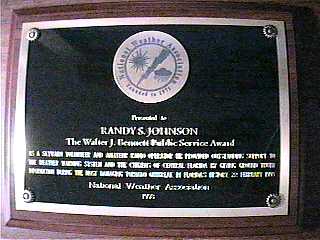
I feel honored and my thanks
go to the people at the N.W.A., National Weather Service, and the
Amateur Radio community!
http://www.nwas.org/award.html#service
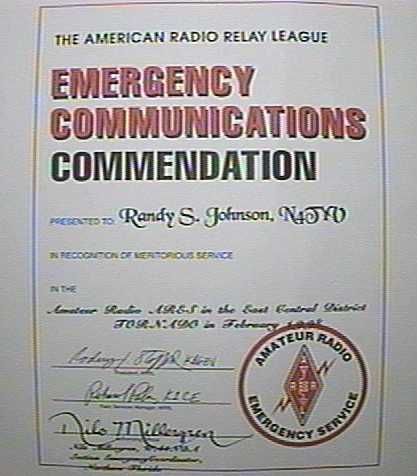
I give my thanks to the A.R.R.L.
and Amateur Radio Organizations providing Emergency Service!
http://www.arrl.org/news/stories/1998/1030/3/?nc=1#n4tyv
QSL.NET
Search QSL.NET
QTH.NET
SWL.NET
DX.QSL.NET
How to support the QSL.NET Web Server
External links are provided for research and information only. The external links on this Web site does not constitute endorsement or approval by me. I am not responsible for the contents on any external link referenced from this Web site.